What is Video Commerce and Why It Matters in 2026

Video commerce is the use of video and real-time interaction to help customers discover, understand, and evaluate products within an eCommerce environment.
At a basic level, this includes formats like shoppable videos, live selling, assisted selling, and product demos placed directly on the site. These formats are visible on the surface. The real shift, however, goes deeper.
Video commerce changes what a product page does. Instead of being a static place that only lists information, the product page becomes interactive. Customers can see the product in context, understand how it is used, and clear their doubts before making a purchase.
In simple terms, video commerce reduces the effort needed to evaluate a product. It presents information in a way that feels closer to how people understand things in the real world. Customers do not have to imagine as much. They can simply see and understand.
Why Traditional Product Pages Are No Longer Enough
To see why video commerce matters, it helps to look at where current eCommerce experiences fall short.
Most product pages are built to be complete. They try to include everything a customer might need. You will usually find multiple images, detailed descriptions, feature lists, technical specifications, and customer reviews.
Completeness, however, does not always mean clarity. Many categories need more than text and images. Products that depend on look, feel, usage, or real-life context are harder to understand this way. A description can explain features, but it cannot show how the product actually works. Images can show how it looks, but not how it behaves. Reviews can share opinions, but they rarely guide the customer step by step.
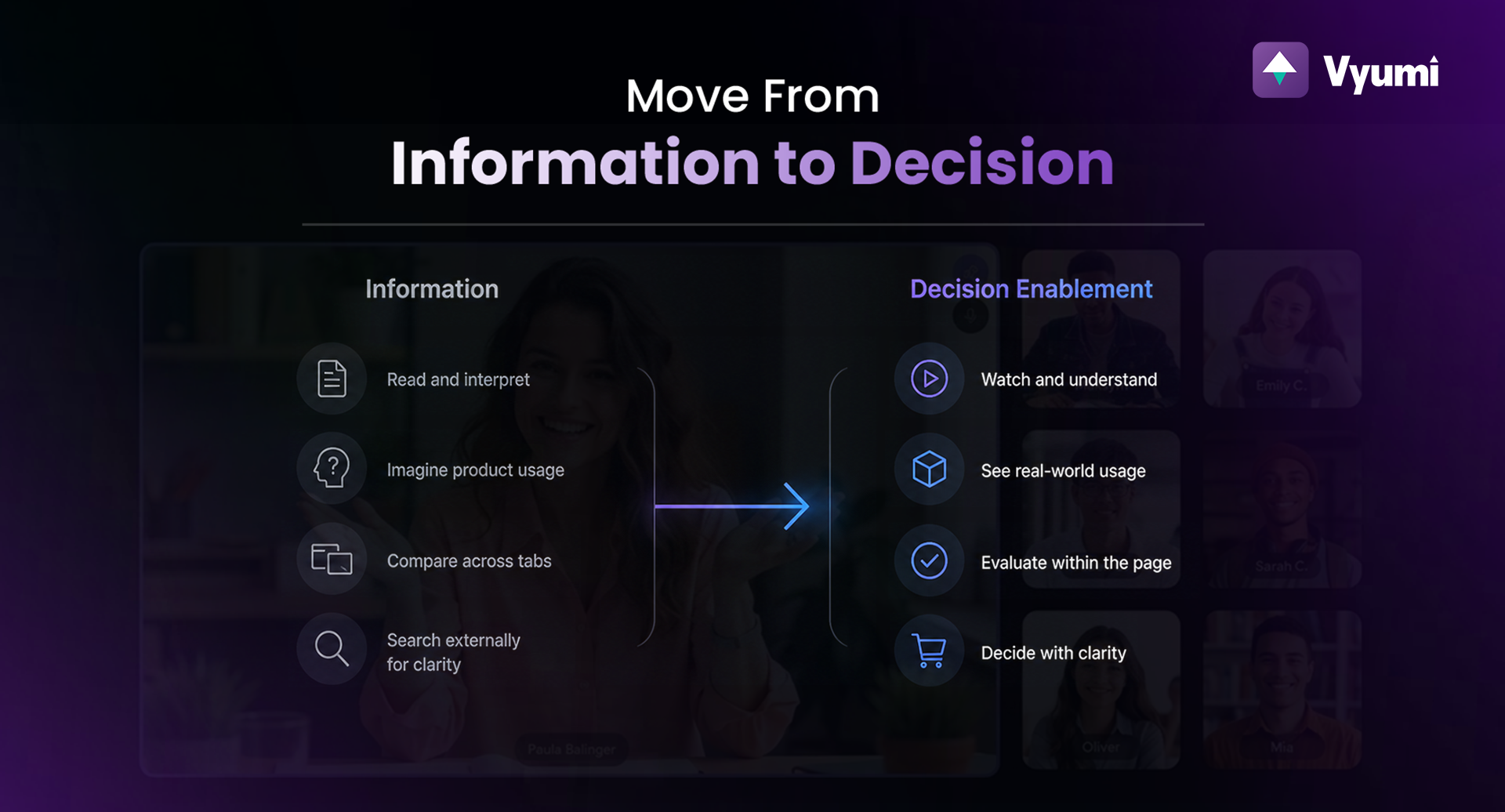
Because of this, customers often leave the site to find answers. They search for videos, compare options across different tabs, or look for recommendations elsewhere. Only after that do they come back to make a decision.
[image]
The Shift from Information to Decision Enablement
eCommerce has traditionally used content to provide information, while video commerce shifts that role towards enabling decisions.
This difference is important because information puts effort on the customer. It expects the buyer to read descriptions, understand specifications, and imagine how the product will work in real life.
Decision enablement reduces that effort by presenting the product in a way that answers the most relevant questions directly.
In categories like beauty or fashion, customers are usually less concerned with technical details and more focused on how a product looks, feels, and performs in real situations. In electronics, the challenge is slightly different, as buyers want to understand how features translate into everyday use.
Video helps address both situations by showing instead of explaining and demonstrating instead of listing.
As a result, customers do not have to rely on interpretation as much. They can understand what matters faster and move more confidently towards a decision.
How Video Commerce Works in Practice
Video commerce is not a single feature. It is a set of connected capabilities built into the buying journey.
One of the most common implementations is shoppable video, where product demonstrations are embedded directly within product or category pages. Customers can watch these videos, explore variations, and move to purchase without leaving the experience.
Another important layer is assisted or real-time interaction, where customers can connect with product experts or representatives when they need help. This approach closely mirrors the in-store experience, where guidance plays a critical role in high-consideration purchases.
Content scalability is the third key component. As product catalogs expand, brands need systems that allow them to create, manage, and distribute video content efficiently across multiple touchpoints. These include storefronts, mobile applications, emails, and even post-purchase channels like packaging.
All of this is supported by a strong technology layer that ensures content is delivered in the right context.
The goal is not simply to add videos, but to place them exactly where customers need clarity, so they can make decisions with confidence at the right moment.
Why Video Commerce Matters in 2026
The rise of video commerce is not accidental. It is being shaped by deeper shifts in customer behavior, content consumption, and market dynamics. Brands that understand these shifts are better positioned to improve both conversion and customer experience.
1. Rising acquisition costs are forcing efficiency
Customer acquisition has become more expensive across digital channels. With increasing competition for attention, bringing users to a website now costs more than ever. In this environment, conversion is no longer optional. Even small improvements can significantly impact overall unit economics, making on-site experience a critical lever.
2. Complex categories need better clarity
The composition of eCommerce has evolved. Categories like beauty, fashion, electronics, and jewelry now dominate online sales. These are high-consideration purchases where customers want to see real usage, detail, and context. Static images and text often fall short in delivering that level of clarity.
3. Content consumption has shifted to video
Customers are now conditioned to consume and understand products through video across platforms. When they land on traditional product pages, the experience feels incomplete. Video commerce aligns the buying journey with how customers already prefer to discover and evaluate products.
4. Video improves engagement and time spent
Video does not just inform, it holds attention. In fact, 84% of video marketers say video has helped keep visitors on their website longer. More time spent often translates into deeper consideration, better understanding, and higher likelihood of conversion.
5. Expectations have moved from fast delivery to fast understanding
Speed is no longer limited to logistics. Customers now expect to understand products quickly as well. They are less willing to read through long descriptions or interpret static visuals. Video simplifies this by delivering information in a faster, more intuitive format.
6. It brings buying closer to real-world experiences
Video commerce bridges the gap between online and offline retail. It introduces elements of demonstration, explanation, and reassurance, making digital buying feel less abstract and more experience-driven.
Business Impact of Video Commerce
When used effectively, video commerce improves multiple aspects of eCommerce performance. Conversion rates tend to improve because customers can resolve their doubts without leaving the platform. They do not need to search elsewhere for clarity, which keeps the buying journey intact.
Customer acquisition costs can also improve indirectly. Better conversion means more value from the same traffic, allowing brands to generate higher returns on their existing marketing spend.
Engagement becomes more meaningful. Instead of passively browsing, customers interact with content that helps them make decisions. Time spent on the site becomes more purposeful and often leads to stronger intent.
In some categories, better understanding before purchase can also reduce return rates. When expectations are clear, the chances of mismatch go down.
These results do not come from adding video alone. They depend on how well video is integrated into the decision-making process.
Common Misconceptions About Video Commerce
Video commerce is gaining traction, but much of its potential is still misunderstood. Many brands approach it with assumptions shaped by traditional video marketing, which limits its real impact. To unlock value, it is important to move beyond surface-level thinking and understand how video actually influences buying decisions.
1. It is only a branding or engagement tool
Video is often treated as a medium for storytelling and awareness. While it does support brand building, its real strength lies in helping customers make decisions. It shows how a product is used, sets the right expectations, and reduces hesitation at critical moments in the buying journey.
2. Adding videos to a website is enough
Simply embedding videos does not lead to meaningful outcomes. The impact depends on where and how videos are used. They need to be placed at high-intent touchpoints and aligned with user behavior so they actively remove friction instead of sitting passively on the page.
3. It is only useful at the top of the funnel
Video is often seen as an awareness tool, but its strongest influence appears closer to the point of purchase. At this stage, customers are comparing options and looking for clarity. Video helps simplify these choices and builds confidence quickly.
4. It is just another content format
Video commerce is not just content layered on top of an existing experience. It functions as an active part of the buying journey. When integrated well, it improves how customers evaluate products and has a direct impact on conversion outcomes.
Frequently Asked Questions
What is video commerce?
Video commerce is the use of video and real-time interaction to help customers discover, understand, and evaluate products within an eCommerce environment. It includes formats like shoppable video, live selling, assisted selling, and product demos placed directly on the site.
How is video commerce different from video marketing?
Video marketing focuses on awareness and storytelling at the top of the funnel. Video commerce sits closer to the moment of purchase — it helps customers evaluate products, answer doubts, and convert. The goal isn't engagement, it's decision enablement.
Which product categories benefit the most?
High-consideration categories see the largest lift: beauty, fashion, electronics, jewelry, and home. These are products where customers want to see real usage, scale, and context before buying — things static images and text cannot fully convey.
Does video commerce reduce returns?
Yes, in many cases. When customers understand a product clearly before buying, expectations are set correctly and the chance of a mismatch goes down. Brands have reported lower return rates on categories where video is integrated at the decision moment.
How does Vyumi support video commerce?
Vyumi provides shoppable video, 1:1 video chat with experts, AI-powered content workflows, and the infrastructure to deliver these experiences at the right moment in the buying journey — across storefronts, mobile, and post-purchase touchpoints.
How do I get started with video commerce on my store?
Start small with one high-intent product page or category. Add a single shoppable video or 1:1 video chat option, measure conversion lift, then expand to more touchpoints. Book a demo with Vyumi to see how this maps to your specific catalog and traffic.